
Earth 2053: Tipping Point is a cooperative game from Crimson Company about preventing climate disaster. The gameplay centers on strategic card play and tableau building.
In Earth 2053: Tipping Point, players each represent a country, working together to battle pollution and climatic dangers. You’ll play cards into a grid system, where a series of escalating events threaten the environment. Use resources from the country board to play key projects that turn the tide, before pollution tips over a literal scale included with the game.
Crimson Company crowdfunded Earth 2053: Tipping Point in 2025, completing fulfillment for many by December. Here’s the Kickstarter overview from Crimson Company’s official YouTube channel to give you a look at some gameplay:
This project quickly earned our pledge with its slick presentation, promising ideas, and a fun theme. My wife and I have enjoyed the theme elsewhere, as in Daybreak. Tipping Point was also another opportunity to support a small team, which we regularly aim for.
The art design is truly catchy, full of dramatic symbols and scenes, from the cards to the country board. Though, it can feel a tad cluttered here and there.
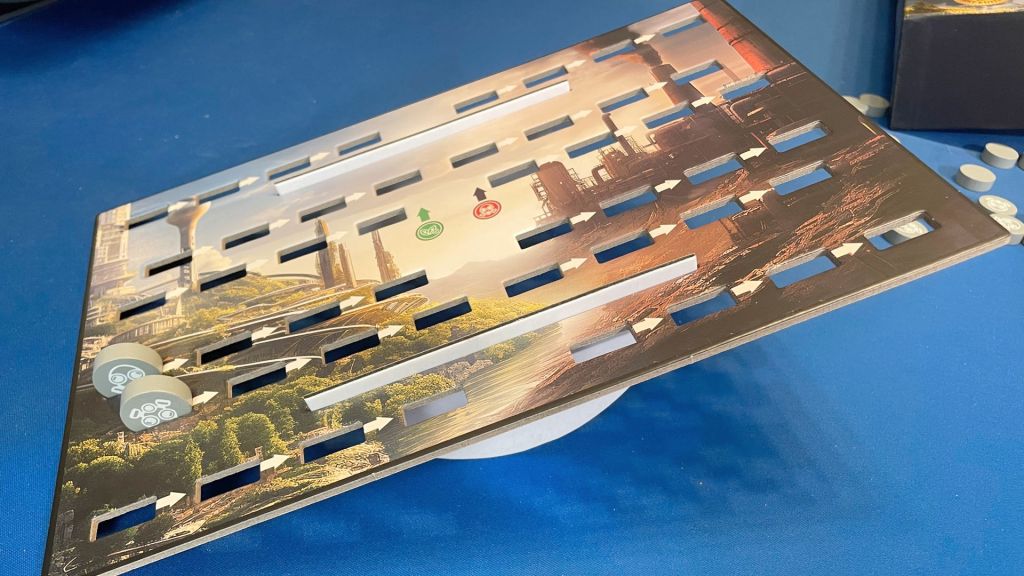
The tipping scale is a terrific idea, plain and simple. It offers a clear view of your tension or progress, and has great table presence. It also naturally fits the overall theme, and is likely a big reason many backers showed up. Neat!
The components are of excellent quality, so I’m impressed such a small team was able to put this together.
Core Gameplay
Thematically, I love the idea of building a literal path forward via card play. However, the grid system doesn’t feel quite so thematic. It is fun on its own feet—it invites players to create careful patterns, and react strategically to events. But it almost seems tangential to me, like it belongs to a different game.
Tipping Point has a lot of design space, and I do enjoy playing it for a while. It just didn’t achieve as much as I hoped it would. The primary goal is to generate influence, no matter what, to overcome events. Unfortunately, this became a little stale over time.
I do appreciate the knowledgeable events, which clearly demanded a lot of care and study. But they don’t ultimately differ very much. I wish that each event’s theme deeply altered the gameplay objectives.
As a result, all of the exhaustive research, a major selling point for the game, feels a bit wasted. This is my main issue with Tipping Point, and it extends to the country boards, too.
I actually enjoy the balancing act of the country board, and their asymmetrical resources! I appreciate the adjacency concept, and the risks. You’ll need to take a lot of drawbacks in order to gain certain benefits, an authentic touch.
This also adds a heftier weight to Tipping Point—but it doesn’t align with the actual complexity of the game. Tipping Point has a lot going on, but for all its moving parts, they simply don’t amount to very much.
Final Thoughts
Tipping Point has many promising ideas. In fact, I happen to enjoy all of its mechanisms, and applaud the commitment to realism. Sadly, gameplay decisions just aren’t satisfying enough—they’re a bit redundant, and goals are limited. This either needed to be simpler, or more complex. Mostly, I’m just disappointed, as Tipping Point doesn’t reach its full potential.
Score: 6.5 / 10
Support LBR and artists by reading more of our Tabletop and Video Game posts!

